Jane Eyre - Original, then an adaptation!
Jul. 8th, 2024 01:48 pm![[personal profile]](https://www.dreamwidth.org/img/silk/identity/user.png) jajalala
jajalalaSo I've been slowly plucking away at the classic Jane Eyre by Charlotte Brontë for awhile, and awhile back I finished it! Overall I really enjoyed it, loved the evocative and moody writing style, how twisty it was and how easy it was to get invested in Jane, I definitely see why it has endured as a classic, though there were a handful of little pieces that I was like "HMM this has not aged well or shows a certain unpleasant bias!"
I love how long it is and the long timespan. When this was recommended to me, I was warned the first part is very overwrought sad orphan times, BUT I LOVED THAT! It's like you know sometimes you DO feel like the saddest and most unlucky girl in the whole wide world, and reading someone enduring those circumstances really connects you with the most miserable and pitiful parts of yourself.
The twists were delightfully well done, I could sense impending doom in a lot of portions, for example when Mr. Rochester was pushing for a wedding... ahaha I was like "NOOO something is DEFINITELY wrong, wtf was that fire about?" and when Jane learned the truth and fled I was like "YESSSS go girl flee!"
And although she ended up in dire straits, when she recovers and then discovers all sorts of surprise fortune it was SUPREMELY satisfying. Same with when she went to her aunt's deathbed and saw how that side of her family turned out--Brontë has a talent for writing people in such realistic ways while also kind of making them parables and examples to contrast against each other. I felt similarly fascinated by the preacher towards the end of the book and his motivations.
At the end, I was not ENTIRELY happy with Jane's final choice... but at the same time it's SO WELL WRITTEN and the romance felt so SINCERE by then, especially with fortunes reversed, I kind of felt like "WELL.... they're happy together! And with the state he's in, he's not going to be able to take advantage of her, so she's probably going to be safe and happy."
Now even though OVERALL I had a riveting time reading it, totally loved it, I also still had some parts that I was like... REALLY?
Principally: WHAT DO YOU MEAN MR. ROCHESTER LOCKED HIS WIFE IN THE ATTIC??? HELLO????? And this is something somewhat justified in the narrative, they're like "Oooh well actually she IS a lunatic so like... this is fine. The only bad part of this is that TECHNICALLY they're married under the eyes of god, so Mr. Rochester shouldn't be trying to marry Jane." It's a horror movie situation--even if Bertha does have mental health issues, her captivity is such an inhumane treatment that I was like "Jane get the FUCK out of there you could be next if he doesn't like you."
Obviously the way mental health is viewed has changed in the many years since that was written, but even so there's such an absence of consideration for Bertha's humanity that I was disgusted. It made me even more sad when she's killed off (by her own fault, setting the mansion on fire and dying "despite Mr. Rochester's attempts to save her" so that he doesn't have to feel guilt about it) so that Jane and Mr. Rochester can have their happy ending... like it's like "Oh what fortune that this human being is dead now so Jane can marry her husband without worries of bigamy!"
There was another much more minor quibble I had when Jane ends up entirely destitute without a penny to her name in a village where she knows no one... she functionally ends up begging at someone's doorstep, but a housekeeper shoos her away while calling her a beggar. Later, when the occupants of the house take mercy and charitably nurse her back to health, and Jane is in more of a state to act like a learned/educated/classy woman, she kind of chastises the housekeeper for calling/treating her a beggar back then when she wasn't "really" a beggar?
Maybe it's something unique about the language back then where beggar really did mean a very specific type of beggar, but the impression I got was that "some people who beg really ARE good people who you SHOULD reach out to and help just in case, UNLIKE ALL THOSE REGULAR BEGGARS WHO ARE REALLY USELESS AND NOT HIGH-CLASS ENOUGH TO CARE ABOUT". It was a hypocritical angle that felt like some unpleasant biases seeping through.
Soon after finishing it, I picked up Escaping Mr. Rochester by L. L. McKinney, an adaptation published in 2024! And had a fun time. It was a sapphic reimagining that focused on a certain section and addressed the biggest issue I had with the original.
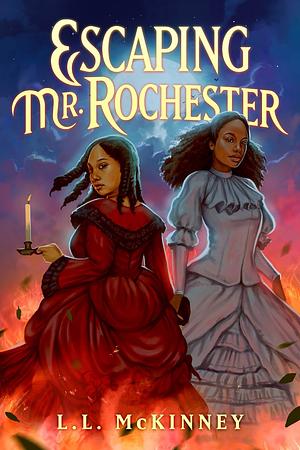
I'll say straight out: This is a young adult novel. I don't mean that in a bad way, more in that it's written in a way that's accessible to any reader above middle-grade reading level and there isn't a ton of moral complexity. I liked that choice in this case, the characters were still grounded enough that I enjoyed reading it, and I'm sure there are a good number of teens out there who read Jane Eyre for school and are like "well I want to read a COOLER version", or teens who will read this and be ignited with a desire to read the original. This is certainly based on and using the original, but it isn't married to it or trying to evoke the same tone. Instead, it's a refreshing young adult adventure/mystery that focuses on two women and treats Mr. Rochester as the antagonist.
What I specifically loved is that Bertha is given a focus, half the book is in her POV, and despite her restraints it is never a question that she is a human being worthy of narrative focus. This book treats Mr. Rochester locking her in the attic as a legitimately sinister and cruel thing to do! It also has some monetary justifications for both him doing that, and for him adopting Adele and seeking Jane as a governess. As the title implies, it's a book all about escaping Mr. Rochester and his evilness!
Is it a complex evil? Not really (I'll sum it up for you now: He's motivated by money)! Which is one reason I might not rec it to every Jane Eyre fan: If you were a fan of the emotional depth and complexity of character of the original Jane Eyre, this is not a story intended to evoke that same vibe. Instead, the antagonist and goals are made pretty straightforward so that the reader can hate Mr. Rochester and cheer when he doesn't get what he wants. HOWEVER I like this both for the young adult novel aspect, where I think it's fine and efficient to just have a straightforward antagonist, and also as part of what I'll call the narrative justice for Bertha. With how little depth and consideration Bertha was given in the original, I really don't mind Mr. Rochester being given so little complexity in return for this adaptation. It's not about him! It's about Bertha and Jane Eyre!
I'll say the romance of the story is not particularly strong, it's kind of just like "Well, here's some hints at their respective gay history prior to this point, now they're hanging out and I guess fall in love!" Even so, I still felt satisfied. Part of my expectation reading sapphic stories is that they'll focus pretty strongly on the women, and even if these two women didn't have a whirlwind romance, they were still central to the narrative in a way that made me happy.
Ultimately of course Jane Eyre is a classic for a reason, it swept me away, but after such an epic story, it was refreshing to have an easy read afterwards written in a somewhat more modern tone that kind of "repairs" one of the most uncomfortable aspects of the original while doing its own thing.
So yes: Jane Eyre is brilliant (newsflash!), but there's certainly room for adaptations to try new things with it. Escaping Mr. Rochester is on the simpler side, but it's doing something that makes me and probably many other people happy to see in a way that's accessible to many readers.
I love how long it is and the long timespan. When this was recommended to me, I was warned the first part is very overwrought sad orphan times, BUT I LOVED THAT! It's like you know sometimes you DO feel like the saddest and most unlucky girl in the whole wide world, and reading someone enduring those circumstances really connects you with the most miserable and pitiful parts of yourself.
The twists were delightfully well done, I could sense impending doom in a lot of portions, for example when Mr. Rochester was pushing for a wedding... ahaha I was like "NOOO something is DEFINITELY wrong, wtf was that fire about?" and when Jane learned the truth and fled I was like "YESSSS go girl flee!"
And although she ended up in dire straits, when she recovers and then discovers all sorts of surprise fortune it was SUPREMELY satisfying. Same with when she went to her aunt's deathbed and saw how that side of her family turned out--Brontë has a talent for writing people in such realistic ways while also kind of making them parables and examples to contrast against each other. I felt similarly fascinated by the preacher towards the end of the book and his motivations.
At the end, I was not ENTIRELY happy with Jane's final choice... but at the same time it's SO WELL WRITTEN and the romance felt so SINCERE by then, especially with fortunes reversed, I kind of felt like "WELL.... they're happy together! And with the state he's in, he's not going to be able to take advantage of her, so she's probably going to be safe and happy."
Now even though OVERALL I had a riveting time reading it, totally loved it, I also still had some parts that I was like... REALLY?
Principally: WHAT DO YOU MEAN MR. ROCHESTER LOCKED HIS WIFE IN THE ATTIC??? HELLO????? And this is something somewhat justified in the narrative, they're like "Oooh well actually she IS a lunatic so like... this is fine. The only bad part of this is that TECHNICALLY they're married under the eyes of god, so Mr. Rochester shouldn't be trying to marry Jane." It's a horror movie situation--even if Bertha does have mental health issues, her captivity is such an inhumane treatment that I was like "Jane get the FUCK out of there you could be next if he doesn't like you."
Obviously the way mental health is viewed has changed in the many years since that was written, but even so there's such an absence of consideration for Bertha's humanity that I was disgusted. It made me even more sad when she's killed off (by her own fault, setting the mansion on fire and dying "despite Mr. Rochester's attempts to save her" so that he doesn't have to feel guilt about it) so that Jane and Mr. Rochester can have their happy ending... like it's like "Oh what fortune that this human being is dead now so Jane can marry her husband without worries of bigamy!"
There was another much more minor quibble I had when Jane ends up entirely destitute without a penny to her name in a village where she knows no one... she functionally ends up begging at someone's doorstep, but a housekeeper shoos her away while calling her a beggar. Later, when the occupants of the house take mercy and charitably nurse her back to health, and Jane is in more of a state to act like a learned/educated/classy woman, she kind of chastises the housekeeper for calling/treating her a beggar back then when she wasn't "really" a beggar?
Maybe it's something unique about the language back then where beggar really did mean a very specific type of beggar, but the impression I got was that "some people who beg really ARE good people who you SHOULD reach out to and help just in case, UNLIKE ALL THOSE REGULAR BEGGARS WHO ARE REALLY USELESS AND NOT HIGH-CLASS ENOUGH TO CARE ABOUT". It was a hypocritical angle that felt like some unpleasant biases seeping through.
Soon after finishing it, I picked up Escaping Mr. Rochester by L. L. McKinney, an adaptation published in 2024! And had a fun time. It was a sapphic reimagining that focused on a certain section and addressed the biggest issue I had with the original.
I'll say straight out: This is a young adult novel. I don't mean that in a bad way, more in that it's written in a way that's accessible to any reader above middle-grade reading level and there isn't a ton of moral complexity. I liked that choice in this case, the characters were still grounded enough that I enjoyed reading it, and I'm sure there are a good number of teens out there who read Jane Eyre for school and are like "well I want to read a COOLER version", or teens who will read this and be ignited with a desire to read the original. This is certainly based on and using the original, but it isn't married to it or trying to evoke the same tone. Instead, it's a refreshing young adult adventure/mystery that focuses on two women and treats Mr. Rochester as the antagonist.
What I specifically loved is that Bertha is given a focus, half the book is in her POV, and despite her restraints it is never a question that she is a human being worthy of narrative focus. This book treats Mr. Rochester locking her in the attic as a legitimately sinister and cruel thing to do! It also has some monetary justifications for both him doing that, and for him adopting Adele and seeking Jane as a governess. As the title implies, it's a book all about escaping Mr. Rochester and his evilness!
Is it a complex evil? Not really (I'll sum it up for you now: He's motivated by money)! Which is one reason I might not rec it to every Jane Eyre fan: If you were a fan of the emotional depth and complexity of character of the original Jane Eyre, this is not a story intended to evoke that same vibe. Instead, the antagonist and goals are made pretty straightforward so that the reader can hate Mr. Rochester and cheer when he doesn't get what he wants. HOWEVER I like this both for the young adult novel aspect, where I think it's fine and efficient to just have a straightforward antagonist, and also as part of what I'll call the narrative justice for Bertha. With how little depth and consideration Bertha was given in the original, I really don't mind Mr. Rochester being given so little complexity in return for this adaptation. It's not about him! It's about Bertha and Jane Eyre!
I'll say the romance of the story is not particularly strong, it's kind of just like "Well, here's some hints at their respective gay history prior to this point, now they're hanging out and I guess fall in love!" Even so, I still felt satisfied. Part of my expectation reading sapphic stories is that they'll focus pretty strongly on the women, and even if these two women didn't have a whirlwind romance, they were still central to the narrative in a way that made me happy.
Ultimately of course Jane Eyre is a classic for a reason, it swept me away, but after such an epic story, it was refreshing to have an easy read afterwards written in a somewhat more modern tone that kind of "repairs" one of the most uncomfortable aspects of the original while doing its own thing.
So yes: Jane Eyre is brilliant (newsflash!), but there's certainly room for adaptations to try new things with it. Escaping Mr. Rochester is on the simpler side, but it's doing something that makes me and probably many other people happy to see in a way that's accessible to many readers.


no subject
Date: 2024-07-08 09:56 pm (UTC)Jean Rhys' Wide Sargasso Sea is probably the most famous spin on Jane Eyre, told from Bertha's POV, growing up in Jamaica and then her life colliding with Rochester. Considering it was written in 1966 it's very 'modern', considered a feminist novel with some serious postcolonial commentary - Jean Rhys grew up in Dominica.
I have to admit I don't like the book much and it's been a long time since I read it but it's fascinated people enough to have been made into both a play and a film a few times as well as being a Stevie Nicks song!
no subject
Date: 2024-07-10 07:09 pm (UTC)Oooh Wide Sargasso Sea sounds like an intriguing take, probably a little more detailed and grounded than Escaping Mr. Rochester, which kind of took a "Black people are just a natural part of Fancy Society" approach to have both Bertha and Jane be black women, similar to how the Netflix adaptations of Bridgerton treats race. I totally get some authors/readers wanting to just SEE black people involved and important and depicted in whatever roles they want without having to 'justify' it (and doubly I love it for Bridgerton in terms of broadening casting and making more opportunities available for IRL non-white actors), but I'm definitely also interested in stories that focus on and address the complex history or race relations, and hopefully Wide Sargasso Sea takes a nuanced look on that if it addresses Bertha's time in Jamaica.
no subject
Date: 2024-07-10 07:30 pm (UTC)As she often points out, she has no looks or particular talent and no family pedigree or money. It wasn't like there were any real opportunities for women at the time and certainly not for one judged ill equipped to make a decent match without a sizeable dowry. She doesn't just walk away, she even leaves behind the worldly goods Rochester had already given her.
As to childhood, I LOVE her response to the minister when he asks her if she knows what she must do to avoid hell. ;D
no subject
Date: 2024-07-15 03:37 pm (UTC)no subject
Date: 2024-07-09 10:37 pm (UTC)I haven't read Jane Eyre either. Or tbh anything by Austen or the Brontës. This post makes me think I should 🤔
no subject
Date: 2024-07-10 07:13 pm (UTC)